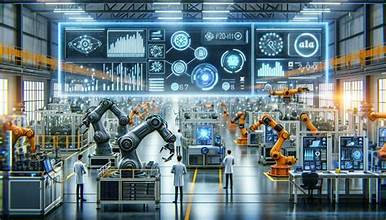
Artificial Intelligence (AI) is no longer confined to cloud platforms, research labs, or office computers. Today, AI is moving closer to where products are made, packages are sorted, machines operate, and decisions must happen instantly. This shift is transforming factories around the world and changing how manufacturers approach productivity, quality, and operational efficiency.
Recent innovations from companies like Supermicro demonstrate how hardware manufacturers are building smaller, faster, and more powerful AI systems capable of running directly inside factories, warehouses, logistics hubs, and production facilities. Rather than sending every piece of information to the cloud, these systems process data exactly where it is generated.
For manufacturers, this means faster decision-making, lower latency, reduced bandwidth costs, and improved reliability.
For Africa and particularly Nigeria, it presents an opportunity to modernize industries, improve productivity, reduce waste, and compete more effectively in a rapidly evolving global manufacturing landscape.
Whether you’re operating a food processing plant, an automotive assembly line, a logistics warehouse, or a pharmaceutical facility, AI at the factory floor is quickly becoming one of the most important technologies shaping the future of manufacturing.
1. Why AI Is Moving Closer to the Factory Floor
The Need for Faster Decisions
Modern factories generate enormous volumes of data every second.
Every conveyor belt, robotic arm, industrial camera, barcode scanner, temperature sensor, and quality inspection system continuously produces information that operators need to analyze.
Traditionally, much of this information was transmitted to cloud servers for processing before instructions were sent back to machines.
Although cloud computing remains extremely valuable, it isn’t always the fastest option.
Every trip between a machine and a remote data center introduces delay. While a few hundred milliseconds might seem insignificant for everyday business applications, those delays can become costly in industrial environments where machinery operates continuously.
Imagine a production line inspecting hundreds of bottles every minute.
If an AI system identifies a defective product even one second too late, multiple faulty products may already have progressed through packaging before corrective action can be taken.
By moving AI processing directly into the factory, manufacturers can analyze information almost instantly.
Instead of waiting for cloud responses, machines receive decisions immediately, allowing production to continue safely and efficiently.
This ability to make decisions closer to where data is created is one of the biggest reasons manufacturers are investing heavily in local AI systems.
Reducing Dependence on Cloud Connectivity
Another reason manufacturers are embracing local AI is reliability.
Internet connectivity can occasionally experience interruptions.
Factories located in remote industrial areas, mining operations, offshore facilities, or developing regions cannot always depend on uninterrupted cloud connections.
Running AI locally allows essential production processes to continue even if internet connectivity becomes temporarily unavailable.
The cloud still plays an important role for reporting, analytics, software updates, and long-term storage.
However, critical operational decisions increasingly happen inside the factory itself.
This hybrid approach combines the scalability of cloud computing with the speed of local intelligence.
2. What Can AI Do Inside Modern Factories?
Computer Vision for Quality Inspection
One of the fastest-growing applications of AI in manufacturing is computer vision.
Instead of relying solely on human inspectors, manufacturers use high-resolution cameras combined with AI models to examine products as they move along production lines.
These systems can identify:
- Surface scratches
- Missing components
- Incorrect labels
- Packaging defects
- Cracks
- Product contamination
Unlike traditional rule-based inspection systems, AI continuously improves as it analyzes more production data.
This allows manufacturers to detect defects that would otherwise be difficult for human inspectors to identify consistently.
As a result, businesses can improve product quality while reducing waste and rework costs.
Predictive Maintenance
Unexpected equipment failures are among the most expensive problems manufacturers face.
A single machine failure can halt production for hours or even days.
AI helps solve this challenge through predictive maintenance.
Rather than waiting for equipment to fail, AI continuously monitors information such as:
- Motor vibration
- Temperature
- Power consumption
- Pressure
- Noise patterns
- Operating cycles
By recognizing unusual patterns, AI can predict potential failures before they happen.
Maintenance teams can then schedule repairs during planned downtime instead of responding to costly emergencies.
For manufacturers operating around the clock, predictive maintenance can significantly reduce downtime while extending equipment lifespan.
Smarter Robotics
Industrial robots have existed for decades.
However, traditional robots follow pre-programmed instructions and struggle when conditions change.
Modern AI-powered robots can adapt.
For example, they can:
- Identify different product sizes
- Adjust movements automatically
- Detect obstacles
- Improve picking accuracy
- Work safely alongside humans
This flexibility allows manufacturers to automate increasingly complex production tasks while maintaining high accuracy.
3. The Technology Behind Factory AI
More Than Just Powerful Computers
Many people assume factory AI simply requires faster processors.
In reality, modern AI systems combine several specialized technologies working together.
These include:
- Multi-core CPUs for general computing
- GPUs for parallel AI processing
- Neural Processing Units (NPUs) designed specifically for AI inference
- High-speed DDR5 memory
- High-bandwidth storage
- Industrial networking
- Industrial cameras
- Edge sensors
Each component plays a different role in processing large volumes of industrial data quickly.
Recent systems introduced by companies such as Supermicro combine these technologies into compact devices capable of operating directly within factories, warehouses, retail locations, and transportation hubs.
This allows businesses to deploy powerful AI capabilities without requiring large server rooms.
Why Smaller AI Systems Matter
Space is often limited inside manufacturing environments.
Control cabinets, production lines, inspection stations, and equipment rooms leave little room for traditional servers.
Compact AI systems solve this challenge.
Many modern platforms are small enough to fit inside industrial cabinets while operating reliably in demanding environments.
This makes AI deployment practical for factories that previously lacked the space or infrastructure for dedicated computing equipment.
Furthermore, smaller systems consume less power and generate less heat, helping manufacturers reduce operational costs.
4. Industries Already Benefiting from Factory AI
Manufacturing Is Leading the Way
Manufacturing remains one of the biggest adopters of AI-powered factory systems. As production demands increase and customers expect higher quality products, manufacturers are looking for technologies that improve efficiency without compromising accuracy.
Today, AI is helping factories automate repetitive tasks while enabling workers to focus on more complex operations.
For example, AI systems can:
- Detect production defects in real time
- Monitor machine performance continuously
- Count finished products automatically
- Verify labels and packaging
- Track inventory movement
- Improve production scheduling
Consequently, businesses can reduce waste, improve consistency, and deliver products to customers faster.
Recent hardware innovations, including compact AI systems announced by Supermicro, demonstrate how manufacturers are moving AI processing closer to production lines. Instead of relying entirely on cloud computing, factories can now analyze large amounts of data locally, reducing delays and improving operational responsiveness.
Logistics and Warehousing
Factories are only one part of the supply chain.
Warehouses and logistics centres also generate enormous amounts of operational data.
Every barcode scan, parcel movement, pallet transfer, loading operation, and vehicle arrival creates information that businesses can use to improve efficiency.
AI helps logistics operators by:
- Optimizing warehouse layouts
- Monitoring inventory automatically
- Improving package sorting accuracy
- Detecting damaged goods
- Assisting autonomous vehicles
- Predicting delivery bottlenecks
As e-commerce continues to grow across Africa, logistics providers will increasingly depend on AI to process higher shipment volumes without significantly increasing operating costs.
Mining, Oil and Gas
Nigeria’s mining and energy industries operate in environments where safety and operational reliability are critical.
AI enables continuous monitoring of equipment operating in harsh conditions.
Using cameras, thermal sensors, vibration monitoring, and predictive analytics, companies can identify equipment failures before they cause production delays or safety incidents.
Rather than relying solely on scheduled maintenance, organizations can perform maintenance only when equipment actually requires attention.
This reduces unnecessary servicing while minimizing unexpected downtime.
Read more about AI IN THE ENERGY SECTOR here
5. What This Means for Nigeria and Africa
An Opportunity to Modernize Manufacturing
Africa’s manufacturing sector continues to grow, driven by increasing urbanization, industrialization, and regional trade initiatives such as the African Continental Free Trade Area (AfCFTA).
However, many factories still rely heavily on manual inspection, paper-based reporting, and reactive maintenance practices.
AI offers an opportunity to modernize these operations.
Instead of replacing workers, AI can assist employees by automating repetitive tasks, improving quality control, and providing better operational insights.
For manufacturers, this means:
- Higher productivity
- Reduced production waste
- Improved worker safety
- Better product consistency
- Lower maintenance costs
Countries that adopt these technologies early will likely become more competitive in regional and international manufacturing markets.
Building Smarter Industrial Infrastructure
Factory AI should not be viewed as a standalone technology.
Its success depends on a broader digital ecosystem that includes:
- Reliable industrial networking
- Connected sensors
- Industrial cameras
- Robotics
- Cloud platforms
- Cybersecurity
- Skilled technical personnel
In Nigeria, investments in broadband infrastructure, industrial automation, and digital skills development will play an important role in accelerating AI adoption.
Government agencies, manufacturers, universities, and technology companies all have roles to play in building this ecosystem.
Connectivity Remains Essential
Although AI increasingly performs computations locally, connectivity remains a vital component of modern manufacturing.
Factories still require secure communications for:
- Software updates
- Remote monitoring
- Fleet management
- Production reporting
- Equipment diagnostics
- Cloud synchronization
- Enterprise resource planning (ERP) systems
As organizations deploy more connected equipment across multiple locations, reliable connectivity becomes even more important.
This is where resilient IoT connectivity solutions, including roaming and multi-network SIM technologies, continue to support digital transformation by keeping industrial assets connected across different operating environments.
Read more about ROAMING SIMS here
6. Challenges Businesses Must Overcome
Investment Costs
Implementing AI in manufacturing requires careful planning.
Businesses may need to invest in:
- Industrial cameras
- Sensors
- AI computers
- Networking infrastructure
- Data storage
- Employee training
Although these investments can appear significant initially, many organizations recover costs through reduced downtime, improved quality, and increased productivity over time.
Rather than attempting a complete factory transformation at once, businesses often achieve better results by starting with a single production line or inspection process before expanding gradually.
Skills and Workforce Development
Technology alone cannot transform manufacturing.
Employees must understand how to operate, maintain, and interpret AI systems effectively.
This creates growing demand for professionals with expertise in:
- Artificial Intelligence
- Data Analytics
- Robotics
- Industrial Automation
- Machine Vision
- Cybersecurity
- Industrial Networking
Educational institutions and technology companies therefore have an important role in preparing the workforce for increasingly intelligent manufacturing environments.
7. The Future of AI at the Factory Floor
Smaller, Smarter, and Faster Systems
Recent product announcements from companies like Supermicro demonstrate an industry-wide trend toward compact, energy-efficient AI platforms capable of delivering powerful performance directly where work takes place.
Future factory AI systems are expected to become:
- More energy efficient
- Easier to deploy
- Faster at processing information
- Better integrated with robotics
- More affordable for medium-sized manufacturers
As hardware continues to improve, AI adoption will likely extend beyond large multinational manufacturers to small and medium-sized enterprises as well.
AI Will Become Part of Everyday Manufacturing
Within the next decade, AI may become as common in factories as programmable logic controllers (PLCs) and industrial robots are today.
Rather than being viewed as an advanced technology, AI will simply become another operational tool that improves productivity, quality, and decision-making.
Manufacturers that begin experimenting today will be better positioned to compete tomorrow.
The goal is not replacing human expertise.
Instead, it is giving workers better information, faster insights, and smarter tools that allow them to make more informed decisions.
Conclusion
Artificial Intelligence is reshaping manufacturing by moving computing power closer to production lines, where decisions must happen in real time.
Recent innovations from technology providers like Supermicro illustrate how compact AI systems are making advanced automation more accessible across manufacturing, logistics, transportation, and industrial operations.
For Nigeria and the rest of Africa, this represents more than a technological trend—it is an opportunity to modernize industries, improve productivity, and strengthen global competitiveness.
However, successful AI adoption requires more than powerful hardware. It depends on reliable connectivity, skilled professionals, secure infrastructure, and a clear digital transformation strategy.
Organizations that invest in these foundations today will be better prepared for the factories of tomorrow.
As industries across Nigeria continue their digital transformation journey, dependable connectivity remains a critical part of every smart manufacturing strategy.
Genyz helps businesses deploy reliable IoT connectivity solutions that support connected devices, industrial automation, logistics operations, and remote monitoring across challenging network environments.
Whether you’re planning your first connected deployment or scaling thousands of industrial devices across multiple locations, our team can help you build a connectivity strategy designed for long-term success.
Talk to Genyz today to discover how reliable IoT connectivity can support your next generation of industrial innovation.